
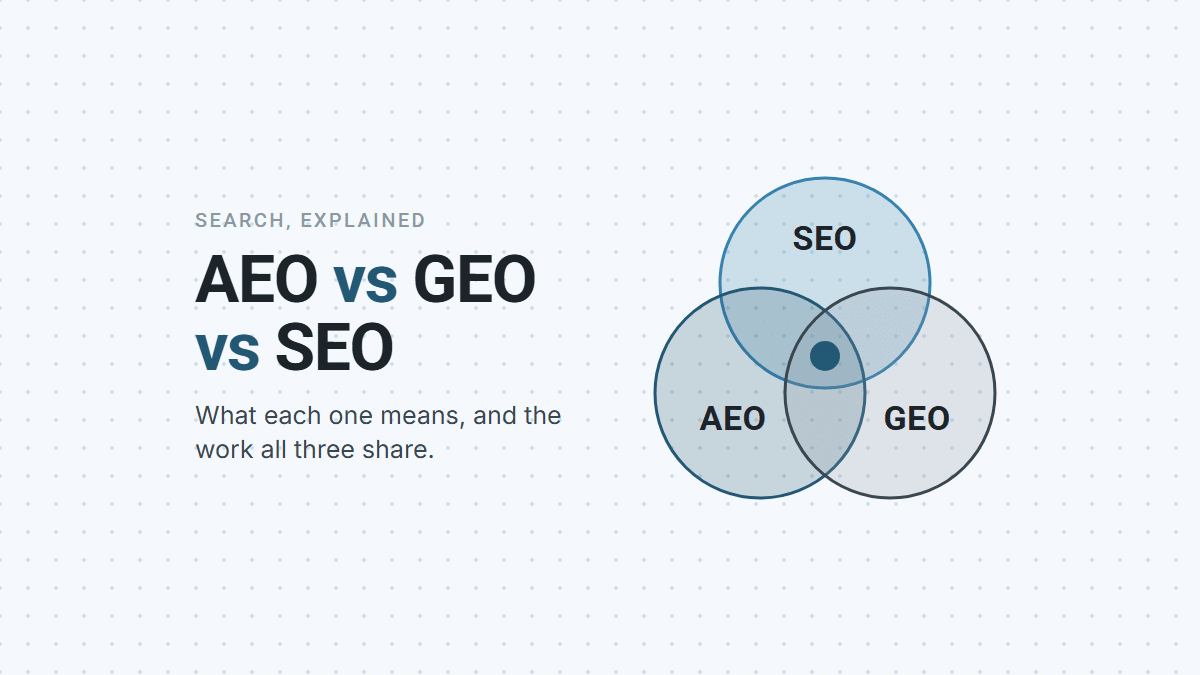

SEO, AEO and GEO are three names for one goal: being the source people find when they look for an answer. Search engine optimization (SEO) earns a place in the list of search results. Answer engine optimization (AEO) earns the direct answer: the featured snippet, the voice reply, the box at the top of the page. Generative engine optimization (GEO) earns a mention or a citation inside an answer that an AI tool writes for the person asking. Most of the work is the same for all three. The differences are real, but they sit on top of a shared foundation, not beside it.
What Is SEO?
SEO is the practice of making a website easy for search engines to find, understand and trust, so its pages rank for the searches that matter. It is the oldest of the three, and it is the base the other two stand on.
SEO has three parts. Technical SEO makes sure search engines can crawl and index each page. On-page SEO makes each page clearly about one topic, with a useful title, a clear description and headings that match what people search for. Off-page SEO builds the reputation that comes from other sites linking to and mentioning yours.
Success in SEO is measured in rankings, clicks and the visits those clicks bring. For a deeper beginner’s walk-through, see SEO for small businesses: easy steps to improve your search rankings.
What Is Answer Engine Optimization (AEO)?
AEO is shaping content so a search engine or voice assistant can lift it as the direct answer to a question. The term is an industry label, not a formal standard, and it grew up around featured snippets, “People also ask” boxes and voice search.
The idea is simple: when someone asks a question, the engine wants one clean answer it can show or read aloud. Content written as a clear question followed by a clear, short answer is easier to lift than the same facts buried in a long paragraph.
One fact keeps AEO honest. Google says its own systems decide which page becomes a featured snippet, and that you can’t mark up a page to make it one (Google Search Central). AEO improves the odds. It doesn’t buy the box.
What Is Generative Engine Optimization (GEO)?
GEO is making your content and your brand more likely to be quoted, cited or recommended inside answers written by AI tools such as ChatGPT, Perplexity, Gemini and Google’s AI Overviews. The term comes from a 2023 research paper, GEO: Generative Engine Optimization, later presented at the KDD 2024 conference.
An AI answer is different from a results page. It reads several sources, then writes one response, and may cite only a few of them. So the question changes from “do I rank?” to “am I one of the sources the answer draws on, and does it describe my brand correctly?”
The paper tested nine ways of rewriting content. Three worked best: citing credible sources, adding quotations and adding specific statistics. They improved how visible a source was in the AI answer by up to about 40% in the authors’ tests. Keyword stuffing didn’t help. Pages that ranked lower in ordinary search gained the most. Those results came from a research setup and from Perplexity, so treat them as direction, not a guarantee.
How Do SEO, AEO and GEO Compare?
| SEO | AEO | GEO | |
|---|---|---|---|
| Where you show up | The list of search results | Featured snippets, answer boxes, voice replies | Inside answers written by AI tools |
| What a win looks like | A high ranking and a click | Your text chosen as the answer | Your brand named or your page cited |
| The unit that matters | The page | The passage that answers one question | The facts and claims an AI can reuse |
| What it rewards most | Relevance, crawlability, links | Clear questions and short, direct answers | Credible, specific, well-sourced content and a consistent brand story across the web |
| How you measure it | Rankings, clicks, visits | Snippets and answer boxes held | How often, and how accurately, AI answers mention you |
What Steps Do All Three Have in Common?
Every step below helps SEO, AEO and GEO at the same time, which is why they come first.
- Make sure you can be found. Pages need to be crawlable and indexed. Submit a sitemap and check that your pages appear in a
site:yourdomain.comsearch. Google states that a page must be indexed and eligible to show a snippet to appear as a link in its AI features (Google Search Central). - Write for people first. Google’s guidance asks whether content offers original information or analysis and whether a reader would bookmark or share it (Google Search Central). That test works for every engine, human or machine.
- Show who is behind the content. Clear author names, real credentials and an honest About page build the trust Google describes as the most important part of E-E-A-T (experience, expertise, authoritativeness and trustworthiness).
- Keep each page about one thing. A clear title, a matching meta description and headings that follow the reader’s questions help a ranking system, a snippet picker and an AI model in the same way.
- Keep your facts the same everywhere. Your name, address, hours, services and prices should match on your site, your business listings and your social profiles. Mismatched facts confuse all three.
- Earn mentions from others. Links and mentions from respected sites remain a core SEO signal, and an AI answer that reads several sources is more likely to name a brand that those sources discuss.
- Keep the site fast and usable on a phone. A slow, broken page loses the visitor whatever sent them there.
What Is Different for Each One?
The differences are about format and focus, not about a separate set of tricks.
SEO only:
- Research the keywords your customers actually type, and map one main keyword to each page.
- Build internal links so related pages point to each other.
- Track rankings and clicks in a tool such as Google Search Console.
AEO only:
- Phrase headings as the questions people ask, and answer each one in the first sentence or two beneath it.
- Use short lists, steps and tables where the answer is naturally a list, a process or a comparison.
- Add structured data only where it matches the visible text on the page. Google says no special markup is needed for its AI features, and asks that any structured data match what the page shows.
GEO only:
- Make claims specific and back them up: name your sources, give exact figures and quote people with real expertise.
- Publish original material that others will cite, such as your own data, guides and plain-language explanations.
- Decide which AI crawlers may read your site. These controls are separate from search. For example, OpenAI uses one crawler, OAI-SearchBot, for ChatGPT search and another, GPTBot, for model training, and blocking GPTBot doesn’t remove a site from ChatGPT search (OpenAI). Blocking Google-Extended doesn’t affect Google Search either.
- Ask the AI tools about your brand and your category every month, and note whether you’re mentioned and whether the details are right.
Which Should a Brand Do First?
Start with the shared foundation, then SEO, then the AEO and GEO layers. The order matters because each layer depends on the one below it.
Google is plain about this: it says there are no additional requirements or special optimizations needed to appear in AI Overviews or AI Mode, and that ordinary SEO best practices apply (Google Search Central). Many AI tools that search the web start from a search index, so a page that can’t be found there is unlikely to be cited.
A practical order:
- Fix crawling, indexing, speed and listing consistency.
- Clean up titles, descriptions and one-topic-per-page structure.
- Rewrite your most important pages so each question gets a direct answer near the top.
- Add sources, specifics and original material to the pages you most want cited.
- Start checking what AI answers say about you, and correct the sources they lean on.
If you’re not sure where your site stands today, what’s in a marketing audit walks through how to check the basics yourself.
A Checklist You Can Use Today
SHARED FOUNDATION (helps SEO, AEO and GEO)
[ ] Site is indexed (site:yourdomain.com shows your pages)
[ ] Sitemap submitted
[ ] Pages load quickly and work on a phone
[ ] Each page has one topic, a clear title and a matching description
[ ] Author names and credentials are visible
[ ] Business name, address, hours and services match everywhere
SEO
[ ] One main keyword chosen for each important page
[ ] Related pages link to each other
[ ] Rankings and clicks tracked monthly
AEO
[ ] Headings phrased as real customer questions
[ ] Each question answered in the first one or two sentences
[ ] Lists, steps and tables used where the answer is one
[ ] Any structured data matches the visible page
GEO
[ ] Key claims backed by named sources and exact figures
[ ] At least one piece of original material others can cite
[ ] AI crawler settings chosen on purpose, not by default
[ ] AI answers about your brand checked monthly for accuracy
What Nobody Tells You About AEO and GEO
Most of AEO and GEO is SEO done carefully, with more attention to clear answers and credible sources. Anyone who sells a secret formula for getting into AI answers is selling something that Google itself says doesn’t exist for its AI features.
What is genuinely new is the scoreboard. A click is no longer the only way to win: being named correctly in an answer counts too, even when nobody clicks. The tools for measuring that are still young, so the most reliable test today is the simple one: ask the AI tools your customers use about your business, and see what comes back.
Build the foundation once, write clear answers to real questions, back them with sources, and you’ll be doing all three at the same time.