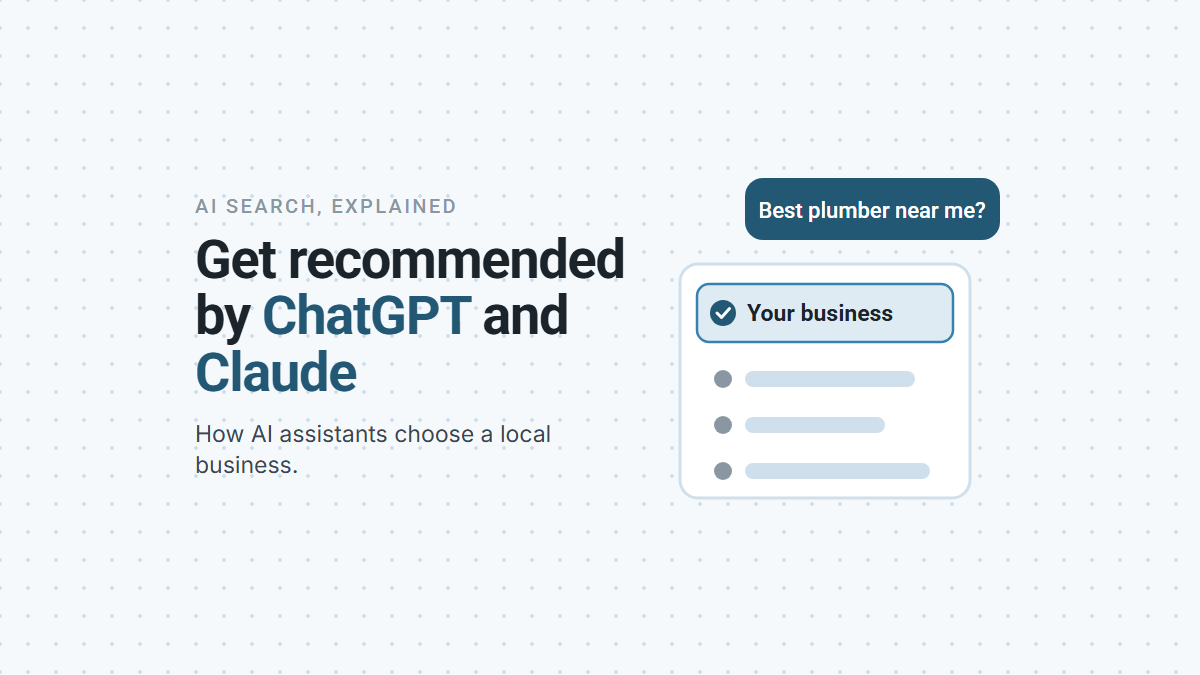

To get your business recommended by ChatGPT and Claude, make it easy to find, easy to understand and talked about by others. These assistants recommend businesses from two places: what the model already learned, and what it finds in a live web search when someone asks. Neither company publishes a ranking formula, but both explain how their search works. That matters now: in BrightLocal’s 2026 survey, 45% of US consumers said they use ChatGPT or another AI tool for local business recommendations, up from 6% a year earlier. Your customers are already asking.
How Do ChatGPT and Claude Decide Which Businesses to Recommend?
They answer from what they learned in training, and when the question needs current or local information, they search the web and summarize what they find. For “who’s a good plumber near me?”, the search side usually decides the answer.
OpenAI explains the ChatGPT side in its help center. ChatGPT rewrites your customer’s question into one or more search queries and sends them to its search partners. It estimates the person’s general location from their IP address, so “good restaurants near me” becomes something like “top restaurants San Francisco.” It may also share that location with “trusted third-party providers” for nearby business listings. OpenAI says it ranks results on several factors meant to surface relevant, reliable information, and that placement is not guaranteed.
Claude works in a similar way. Anthropic runs a crawler called Claude-SearchBot to improve its search results, and says blocking it may reduce a site’s visibility in them (Anthropic). Claude’s live searches reportedly run on Brave Search (TechCrunch), an independent search index.
Two things follow. First, if search engines and listing services can’t find accurate details about you, an AI assistant can’t either. Second, nobody outside these companies knows the exact weighting. Anyone who claims to has guessed.
If the terms AEO and GEO are new to you, AEO vs GEO vs SEO explains them in plain words.
What Makes a Business Easier for AI to Recommend?
Clear, consistent facts about you, in many places, plus a reputation other people describe. An assistant reading several sources is more confident naming a business those sources agree on.
| Signal | Why it matters | Where to work on it |
|---|---|---|
| Consistent listings | ChatGPT gets nearby business listings from third-party providers. Conflicting names, addresses or phone numbers make you look like two businesses, or none | Google Business Profile, Bing Places, Apple Business Connect, Yelp and your trade’s directories |
| Reviews | 82% of consumers read AI-written review summaries (BrightLocal 2026). Reviews that describe the job and the town give an AI something specific to repeat | Every platform customers already use, not just one |
| Mentions on other sites | In an Ahrefs study of 75,000 brands, how often a brand was mentioned across the web tracked closely with how visible it was in ChatGPT and Google’s AI features. Mentions on YouTube tracked most closely | Local news, trade associations, the chamber of commerce, podcasts, YouTube |
| A clear website | Your site is the one source you control. A page that states the service, the area you cover and what it costs is easy to quote | Your service pages, About page and FAQs |
| Crawler access | If ChatGPT’s search crawler is blocked, your site won’t appear in its search answers. Blocking Claude’s may reduce your visibility there | Your robots.txt file and your host or firewall settings |
One caution on the Ahrefs numbers. They show that mentions and visibility go together, not that one causes the other, and Ahrefs says so itself (Ahrefs). The likeliest reading is that both come from the same thing: people talk about the business.
What Should a Service Business Do First?
Fix the facts, then earn the talk. The first three steps are one-time fixes. The last two never stop.
- Let the search crawlers in. OpenAI says a site must allow its OAI-SearchBot crawler to be eligible for ChatGPT search, and that your host or content delivery network must not block it either (OpenAI). Anthropic says blocking Claude-SearchBot may reduce your visibility in Claude’s search results. The training crawlers (GPTBot and ClaudeBot) are a separate choice and don’t control search.
- Make your details match everywhere. Your business name, address, phone number, hours and list of services should be identical on your website and every listing. A roofer listed as “Smith Roofing LLC” in one place and “Smith & Sons Roofing” in another has split its own reputation in two.
- Give each service and each town a clear page. A real estate agent who covers three towns should say so, town by town, with what they actually do there. An accountant should state which kinds of clients they serve and roughly what it costs. Answer the questions customers ask you on the phone. For the listing side, optimizing your Google Business Profile covers the basics.
- Ask for reviews that say what you did. “Fixed our burst pipe in Danbury on a Sunday” tells an assistant far more than “great service.” Ask every happy customer, and make it easy with a direct link.
- Get mentioned by people who aren’t you. Sponsor a local event, join your trade association’s member directory, offer to answer a reporter’s question, post short how-to videos. Each mention is another source that agrees you exist and do good work.
Here’s the robots.txt entry that lets both search crawlers read your whole site. Your web developer or host can confirm nothing else blocks them:
User-agent: OAI-SearchBot
Allow: /
User-agent: Claude-SearchBot
Allow: /
How Can You Check Whether AI Recommends You?
Ask the assistants the questions your customers ask, the same way every month, and write down who they name. It’s free, and it shows you what customers see.
Answers change from one ask to the next, so one check proves little. Run the same questions in both tools, with search turned on, in a new chat each time, and look for the pattern over several months. If you’re not sure your basics are in order before you start, what’s in a marketing audit walks through how to check them yourself.
MONTHLY AI RECOMMENDATION CHECK
Date: ________   Tool: ChatGPT / Claude   Search on: yes
Ask each question in a new chat. Use your real service and town.
[ ] "Who is the best [service] in [town]?"
[ ] "Can you recommend a [service] near [town] for [specific job]?"
[ ] "Who should I hire to [job] in [town]?"
[ ] "Is [your business name] any good?"
[ ] "What does [your business name] do, and where?"
For each answer, note:
[ ] Were you named? (yes / no / position)
[ ] Which competitors were named instead?
[ ] Were your details right (name, phone, area, services)?
[ ] Which sources did it cite or link?
Act on what you find:
[ ] Wrong details: fix the cited source first, then your listings
[ ] Competitors named: look at the sources cited for them
[ ] Not mentioned at all: check crawler access and listings
The cited sources are the most useful part. They show you exactly which websites the assistant trusted for your town and your trade, and those are the places to be listed, reviewed and mentioned.
What Did We Find When We Checked Our Own Business?
We ran these questions on Symphony Core in October 2026. Both assistants got our prices right and our address wrong. The same three problems are worth looking for in your own answers.
- Old details outlive the change. We moved out of our old office in August 2026 and took its address off our website. Two months later, ChatGPT and Claude both still gave it as our address. The sources behind those answers were out of date: an older copy of our contact page and our LinkedIn profile. Our Facebook page still named the old town too. Fixing your website isn’t enough. Every profile has to change too, and old copies take time to drop out of what the assistants read.
- Reviews the assistants can’t find don’t help you. Our Google Business Profile has eight reviews, all five stars. Neither assistant found any of them, and both said there wasn’t enough independent evidence to judge us. The review section on our homepage was broken, and our Facebook page had no reviews at all.
- The businesses that got named had a page for the job. We asked both assistants which companies could set up follow-up and review requests for a plumbing company in Columbus, Ohio. Neither named us. ChatGPT didn’t name us for a real estate agent in Austin, Texas, either. Most of the companies it did name had a page aimed at that trade, saying what’s included and what it costs. In Connecticut, our home state, ChatGPT named us first, based on wording our website no longer uses. Claude didn’t name us.
The useful part was the sources, not the answers. Every wrong detail traced back to a page we could find and fix. That’s one round of questions, so we’ll ask them again in a month and compare. The full set of checks is in what an AI visibility audit checks.
Here’s what nobody tells you: there’s no switch that gets your business recommended, and no one can guarantee a spot. OpenAI says so plainly, and the answers shift from one question to the next. Be wary of anyone who promises a ranking in ChatGPT. What does work is unglamorous: accurate details everywhere, a website that answers real questions, and customers and local sources who talk about you. That’s good local marketing, done consistently, and the AI assistants are reading the results.
If you’d like a second pair of eyes on where your business stands, book a demo and we’ll walk through it with you.