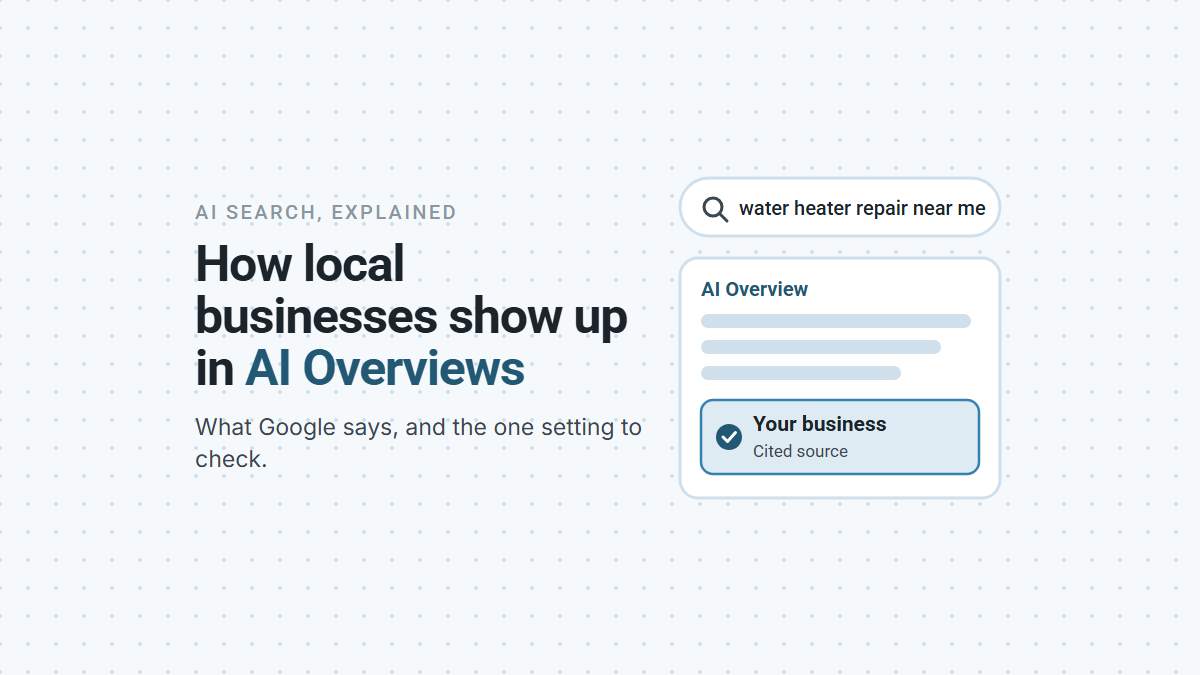

A local business shows up in Google’s AI Overviews the same way it shows up in Google: with pages Google can index, an accurate Business Profile, and content worth citing. Google says there are no extra technical requirements, no special markup and no AI text files. There is one setting worth checking, though. Since August 2026, every website has a Search Console control that includes it in AI Overviews and AI Mode, or keeps it out. Here’s what Google actually says, and what a service business should do about it.
What Does Google Say It Takes to Appear in AI Overviews?
A page has to be indexed and eligible to show a snippet in ordinary Google search, and Google says there are no additional technical requirements (Google). Meeting them makes you eligible. It doesn’t guarantee a place, and AI Overviews only appear when Google decides they add something to the normal results.
Google’s guide explains why ordinary search work still counts (Google). AI Overviews and AI Mode are built on Google’s core ranking systems. They pull relevant pages from the search index and write an answer from them, with links to the pages they used. They also run related searches in the background. A question about fixing a weedy lawn might also look up herbicides and chemical-free weed removal, so a page that answers one of those side questions well can be cited too.
Google addresses the new labels directly. It says optimizing for AI search “is optimizing for the search experience, and thus still SEO.” If those labels are new to you, AEO vs GEO vs SEO explains them.
Which Settings Could Keep Your Business Out?
A Search Console setting, a crawler block or a snippet setting on your pages can each keep you out of AI Overviews, even when everything else is right. Here’s where each one lives and what it should say:
| Setting | Where it lives | What it should say |
|---|---|---|
| Search generative AI control | Search Console, under Settings, then Search generative AI | “Include” (the default). “Exclude” keeps your links and content out of AI Overviews and AI Mode (Google) |
| Crawler access | Your robots.txt file, plus any firewall or content delivery network | Googlebot allowed. Google lists open crawling, including at the hosting and network level, as a best practice |
| Snippet controls | A robots meta tag on each page (nosnippet, max-snippet) |
Not set, unless you mean to limit what Google shows. A page must be able to show a snippet to be eligible |
| noindex | A robots meta tag or HTTP header | Not on any page you want found. It removes the page from Google entirely |
| Google-Extended | Your robots.txt file | Your choice. It limits AI training, not your place in AI Overviews |
The Search Console control is the newest of these, and the easiest to miss because nothing on your website shows it. Google rolled it out to every site on August 31, 2026, and says a change takes a few days to apply. If you’ve never opened Search Console, verifying your site there is worth doing anyway: Google recommends it for spotting technical problems.
What Matters Most for a Local Service Business?
An up-to-date Business Profile, pages that say plainly what you do and where, and content that only you could have written. Google’s guide names each of these.
- Keep your Business Profile current. Google says Business Profiles can help a business’s services appear in AI responses as well as ordinary results. Optimizing your Google Business Profile covers the details.
- Put the facts on the page as text. Google recommends keeping important content in text form. Your services, the towns you cover, your hours and what a typical job involves should be readable on the page, not only in an image.
- Write what you know, not what everyone knows. Google contrasts generic “commodity” content, its example being a list of tips for first-time homebuyers, with first-hand experience nobody else can offer. For a plumber, that’s the difference between “10 signs you need a new water heater” and a page on what replacing water heaters in your town’s older houses actually involves.
- Don’t build a page for every way someone might search. Google warns that making separate pages for query variations mainly to influence rankings breaks its spam policy on scaled content. A page for each town you genuinely serve, saying what you genuinely do there, is fine. Dozens of near-identical town pages aren’t.
- Add your own photos and videos. Google says its AI features can show relevant images and video, so real photos of your work give it more to show.
Google also lists what you can skip. You don’t need an llms.txt file, to break pages into small chunks, to rewrite your pages for AI, or special schema markup. Structured data is still worth keeping, since it helps with other search features. And chasing mentions on other websites that aren’t real doesn’t help, because Google’s spam systems work against it.
How Do You Know If You’re Showing Up?
Open the Generative AI performance report in Search Console. It shows how often links to your site appeared in AI Overviews and AI Mode, which pages appeared and from which countries (Google). If the report isn’t there, Google says it’s usually because your site hasn’t had enough impressions yet, or because the site is excluded in the control above.
You can also search the questions your customers ask, though AI Overviews don’t appear on every search and results depend on where the searcher is. Here’s a check to run once, then every few months:
GOOGLE AI OVERVIEWS CHECK
[ ] Search Console: Settings > Search generative AI says "Include"
[ ] robots.txt and any firewall or network service allow Googlebot
[ ] No noindex or nosnippet on pages you want found
[ ] Business Profile: hours, services, service area and phone current
[ ] Each service page states the service, the towns and the typical job
    as text on the page
[ ] Search Console: open the Generative AI performance report
    and note impressions and top pages
[ ] Search three to five questions customers ask, naming your town,
    and note which businesses the AI Overview cites
The honest part: Google says meeting every requirement doesn’t guarantee your business will be crawled, indexed or shown. It also warns that “no third-party tool has access to our internal ranking or AI systems,” so be careful with anyone selling a shortcut. What works is the work that already helped you in Google: an accurate profile, clear pages and things worth saying. The same groundwork helps you get recommended by ChatGPT and Claude too.
If you’d like a second pair of eyes on your Search Console settings and Business Profile, book a demo and we’ll go through them with you.