
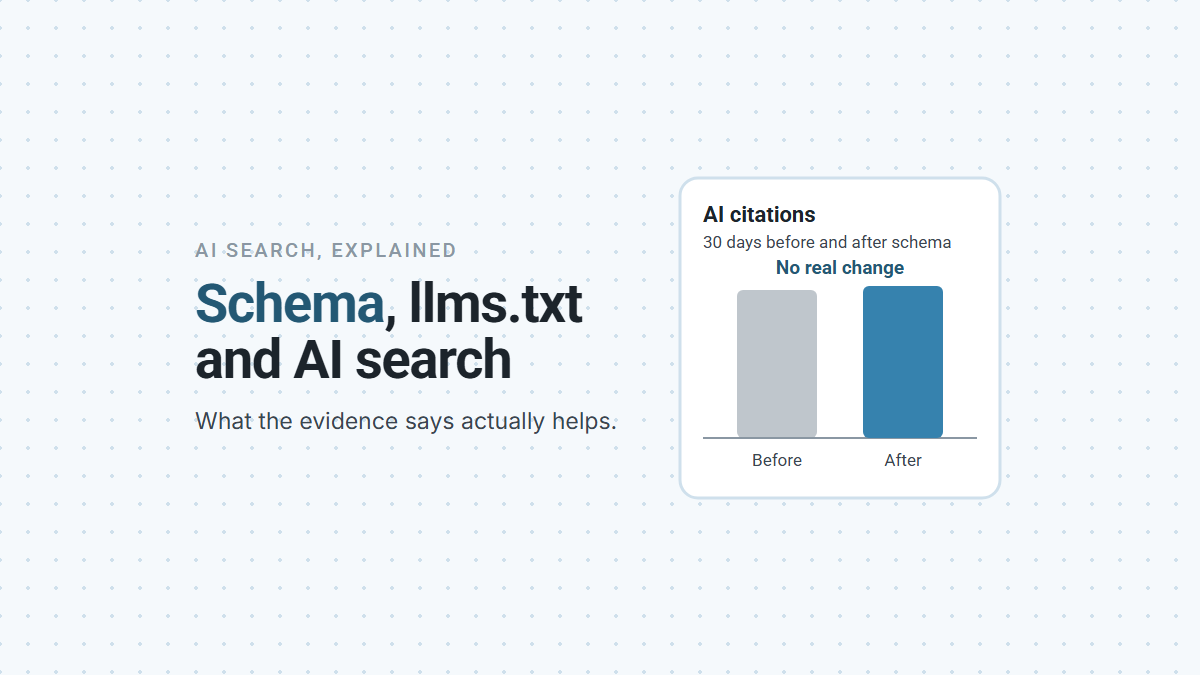

Does schema markup help ChatGPT or Google’s AI recommend your business? On the best evidence so far, not on its own. In a May 2026 study of 1,885 pages that added schema, Ahrefs found no meaningful rise in AI citations on ChatGPT, Google AI Mode or AI Overviews. Google says its AI features need no special markup and ignore llms.txt files. That doesn’t make schema useless, because it still feeds business details into ordinary Google results. Here’s what the evidence says, what to keep and what to skip.
What Did the Biggest Test of Schema and AI Citations Find?
Pages that added schema were cited by AI about as often as similar pages that didn’t. It’s the most careful test published so far, and the result is close to nothing.
Ahrefs tracked 1,885 pages that added schema markup between August 2025 and March 2026, and compared each with three similar pages that never added it (Ahrefs). It counted AI citations for 30 days before and 30 days after:
| Platform | Change compared with similar pages | What it means |
|---|---|---|
| ChatGPT | +2.2% | Too small to tell apart from no change |
| Google AI Mode | +2.4% | Too small to tell apart from no change |
| Google AI Overviews | −4.6% | A small drop Ahrefs couldn’t explain |
Ahrefs is open about the limits. Every page in the test was already cited heavily by AI, so schema might matter more for a page AI hasn’t noticed yet. The schema types were pooled together, and the test only ran for 30 days. Its own summary: if you’re already doing the rest of your SEO well, schema isn’t the missing piece.
You may see a different statistic quoted: pages that AI cites are about three times more likely to have schema. Ahrefs found that too, and it’s a correlation. Well-run websites tend to do many things at once, schema among them, so it doesn’t show that schema caused the citations.
Does Google Need Schema or llms.txt for AI Overviews?
No. Google says you don’t need special markup, AI text files or llms.txt to appear in AI Overviews or AI Mode (Google).
An llms.txt file is a proposed text file that summarizes a site for AI tools. Google says its search ignores these files, so having one neither helps nor hurts you there. It’s fine to keep one for other services that use it. Neither OpenAI’s nor Anthropic’s documentation for their crawlers mentions llms.txt.
Google lists a few other popular ideas it says you can ignore: breaking pages into small chunks for AI, rewriting your pages in a special way for AI, and chasing mentions on other sites that aren’t genuine. It also says structured data isn’t required for AI search, though it’s worth keeping for other reasons. And it suggests checking any “AEO” or “GEO” advice against its official guidance. If those terms are new to you, AEO vs GEO vs SEO explains them.
So Is Schema Worth Having at All?
Yes, for ordinary search, as long as it matches what’s on the page. Google says local business markup can help it show your details, such as hours, in a knowledge panel when someone searches for your business, though it doesn’t guarantee that (Google).
One rule matters more than the rest: Google says not to mark up information that visitors can’t see on the page (Google). Markup listing hours, services or areas that the page itself doesn’t show is the wrong way round. The facts belong in the visible text first, and the markup should repeat them.
For most service businesses, this is a one-time job. A website’s SEO plugin often handles the basics, and a developer can check that the business name, address, phone number and hours in the markup match the page and your Business Profile.
What Should You Spend the Time on Instead?
On what both Google and the research point to: clear facts on your pages, an accurate Business Profile, and other people talking about you. In a separate Ahrefs study of 75,000 brands, how often a brand was mentioned across the web tracked much more closely with AI visibility than Domain Rating, Ahrefs’ measure of a site’s backlinks (Ahrefs). That’s also a correlation, but it points the same way as Google’s advice.
| Keep or skip | What | Why |
|---|---|---|
| Keep | Your services, towns, hours and phone as visible text on the page | Google recommends text, and every AI tool reads the page |
| Keep | Accurate local business schema that matches the page | Helps ordinary Google results; must match what visitors see |
| Keep | An up-to-date Google Business Profile | Google says it helps businesses appear in AI answers |
| Skip | An llms.txt file for Google’s sake | Google says its search ignores it |
| Skip | Rewriting or chunking pages “for AI” | Google says it isn’t needed |
| Skip | Paying for a schema package that promises AI citations | The best test found no meaningful lift |
If someone offers you an AI search fix, these questions sort evidence from sales talk:
QUESTIONS TO ASK BEFORE PAYING FOR AN AI SEARCH FIX
[ ] What evidence shows this changes AI citations?
    Is it a controlled test, or a correlation?
[ ] Which AI tools does it affect, and how will we measure
    before and after?
[ ] What does Google's own guidance say about it?
[ ] Does it put anything on the site that visitors can't see?
[ ] What happens if nothing changes after 60 days?
The honest part: this evidence is young, and AI search changes quickly. One good study and Google’s current guidance are the best information available, not the last word. If you want to know whether something works for your own site, measure before and after, for example with Search Console’s Generative AI performance report. And remember what gets a business recommended by ChatGPT and Claude: accurate listings, real reviews and people who talk about you. No file or markup replaces that.
If you’d like help sorting what your site actually needs from what it doesn’t, book a demo and we’ll go through it with you.